
Tuesday Tips Archive
2026
Did You Know?
Tuesday Tips are based on research questions from our community of LAT Compendium subscribers. You are not alone! Finding the right case doesn’t have to be a challenge. Let inHEALTH’s Live Chat experts help you find what you need.
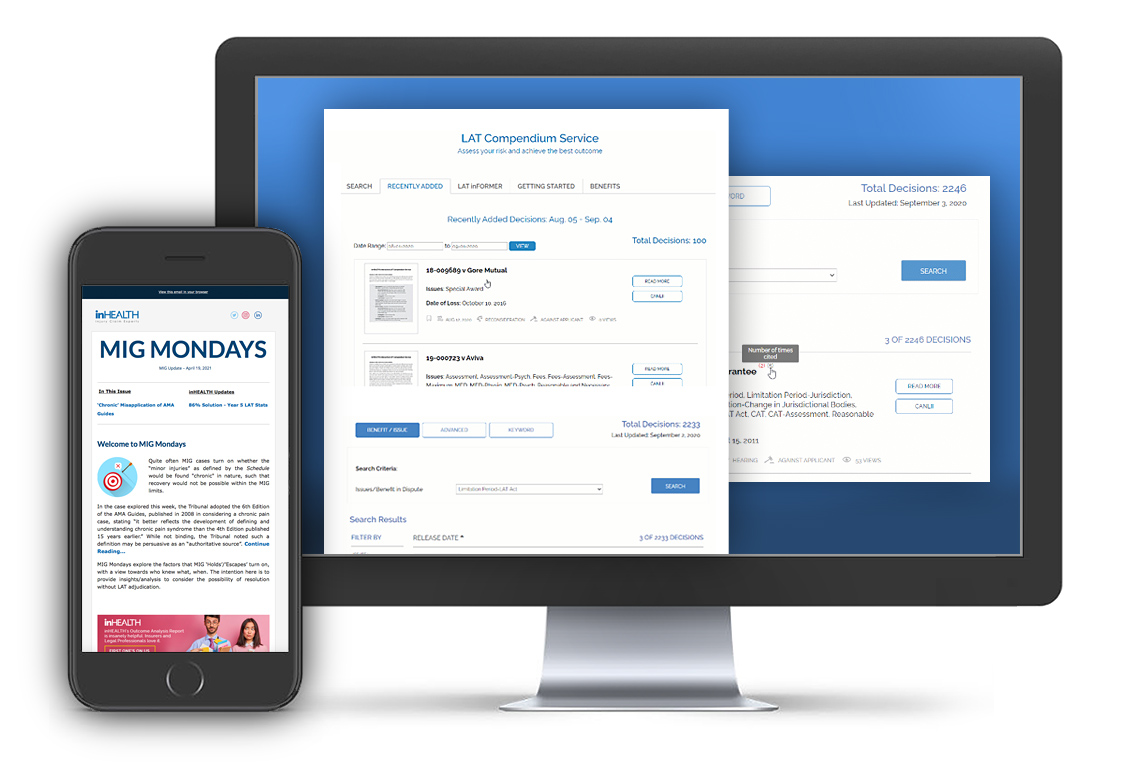
LAT Compendium Service
Apply Tuesday Tips with access to inHEALTH’s LAT Compendium Service! A subscription based service with the most up to date decisions from the Licence Appeal Tribunal (LAT). Includes access to inHEALTH’s LAT database, newsletter notifications and SABS experts.
March Tips
Mastering MIG Searches
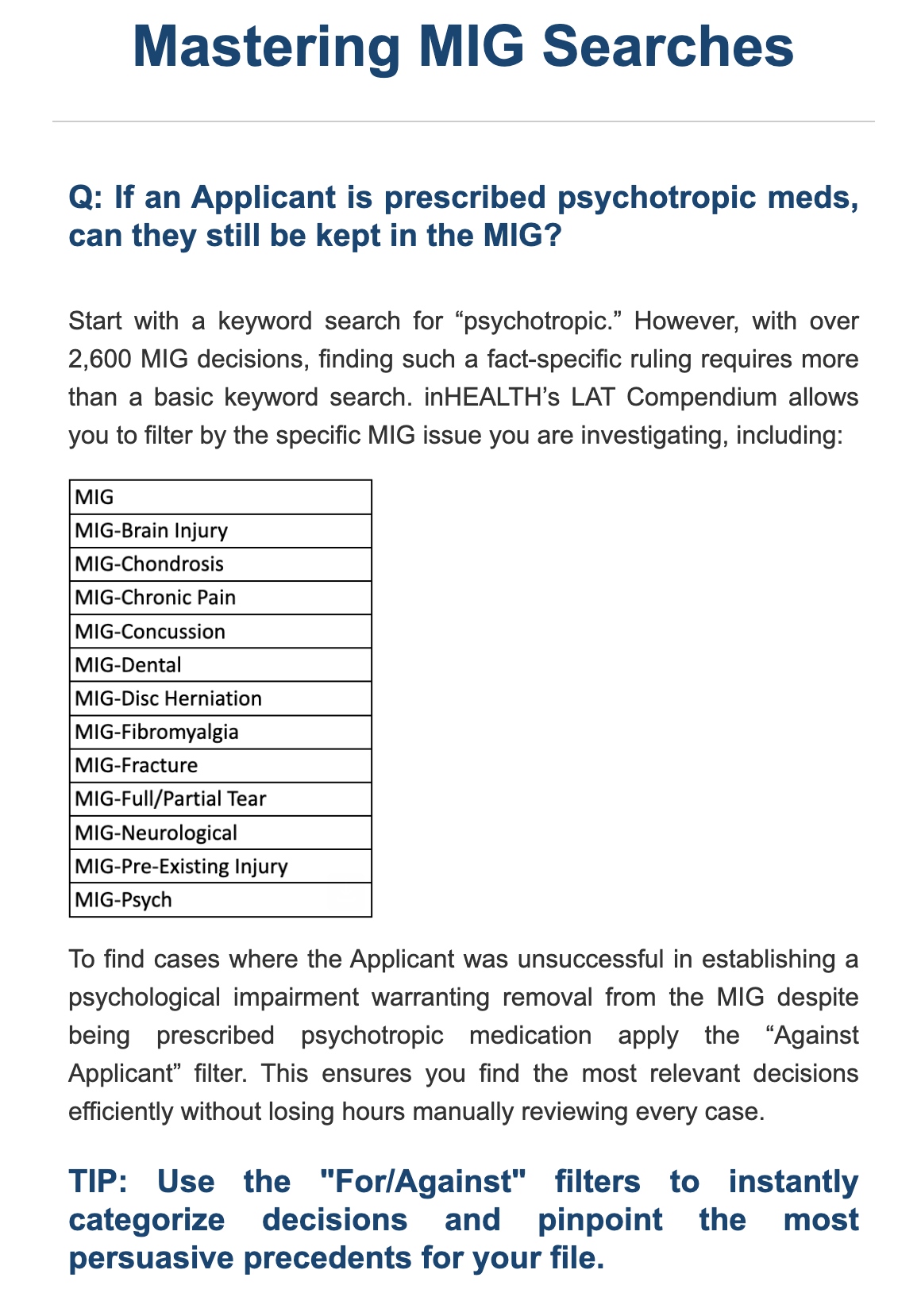
Sign up for a Free Trial to inHEALTH’s LAT Compendium:
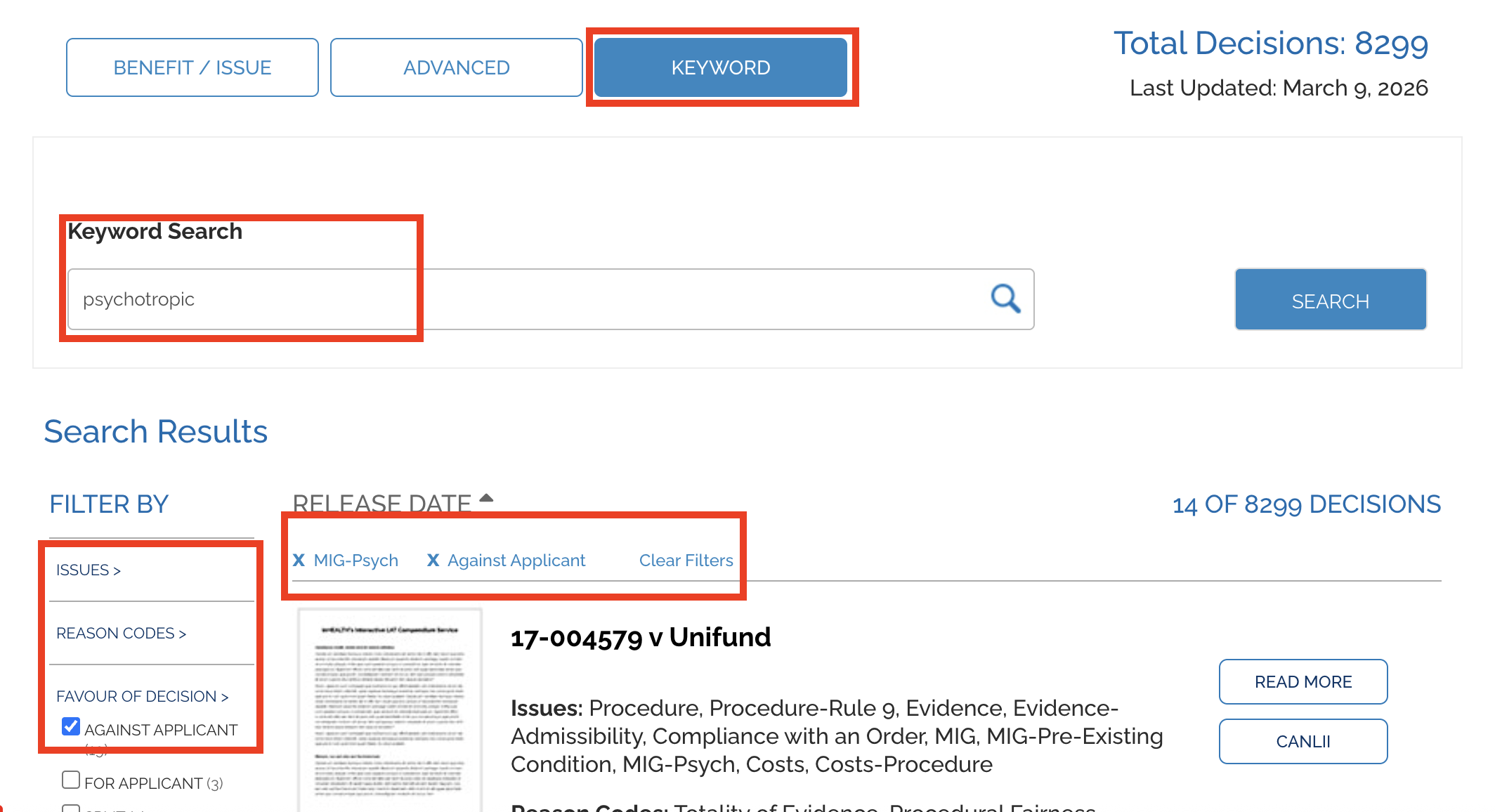
1. Go to Keyword Search and enter: psychotropic
2. Filter By: Issues – MIG Psych
3. Filter By: Favour of Decision – Against Applicant
4. Total Results 14 decisions on inHEALTH’s LAT Compendium
22-013167 v Economical: Lastly, Adjudicator Bhargava found the Applicant did not suffer psychological impairment. While Dr. Wadhwa’s CNRs indicated that he prescribed psychotropics in March 2021, the Applicant submitted no evidence of the prescription being filled. The psychotropics prescribed by Dr. Lee in January 2021 was filled only once. As such, the Applicant was held within the MIG, and not entitled to the Treatment Plans in dispute.
24-003977 v Co-operators: The Applicant was held within the MIG as there was no evidence that he suffered from accident-related psychological impairments or that his pre-existing depression and anxiety prevented his maximal recovery. In fact, the CNRs of Dr. Ahmed and Dr. Utsalo indicated that in November 2023, eight months after the accident, the Applicant discontinued his prescribed depression medication. The Tribunal found the Applicant’s pre-existing psychological symptoms were aggravated by the stoppage of his prescription medicines and not due to the subject accident, as evidenced by the IE report of psychiatrist Dr. Hines dated November 2024. The Tribunal found the Applicant only complained of “on and off” depression, low energy and stress in December 2023, which was related to his work stress.
Don’t miss key LAT decisions on sufficient notice inHEALTH’S SABS Experts are here to help – Connect on Live Chat!
Recurring Errors by the LAT
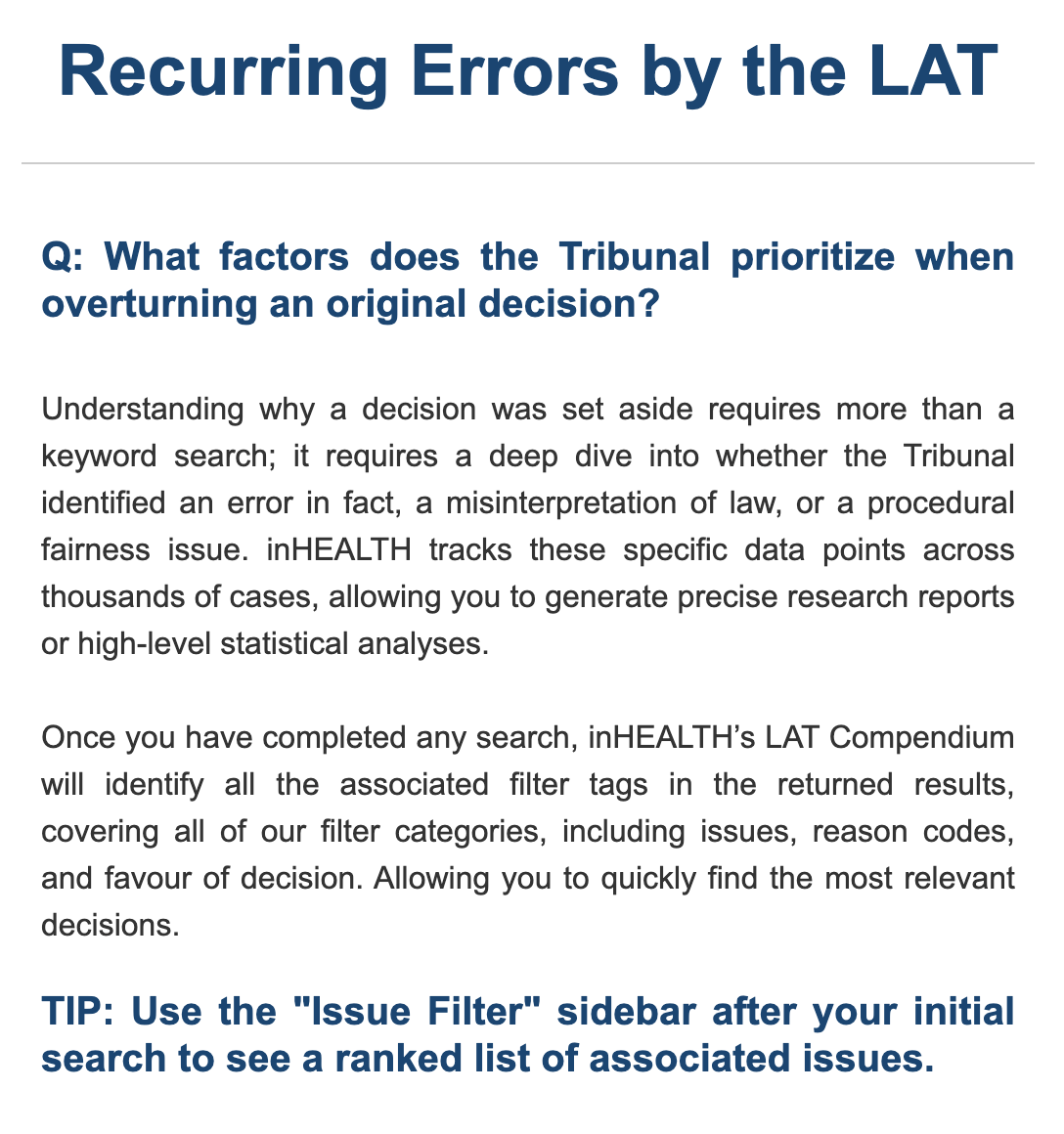
Sign up for a Free Trial to inHEALTH’s LAT Compendium:
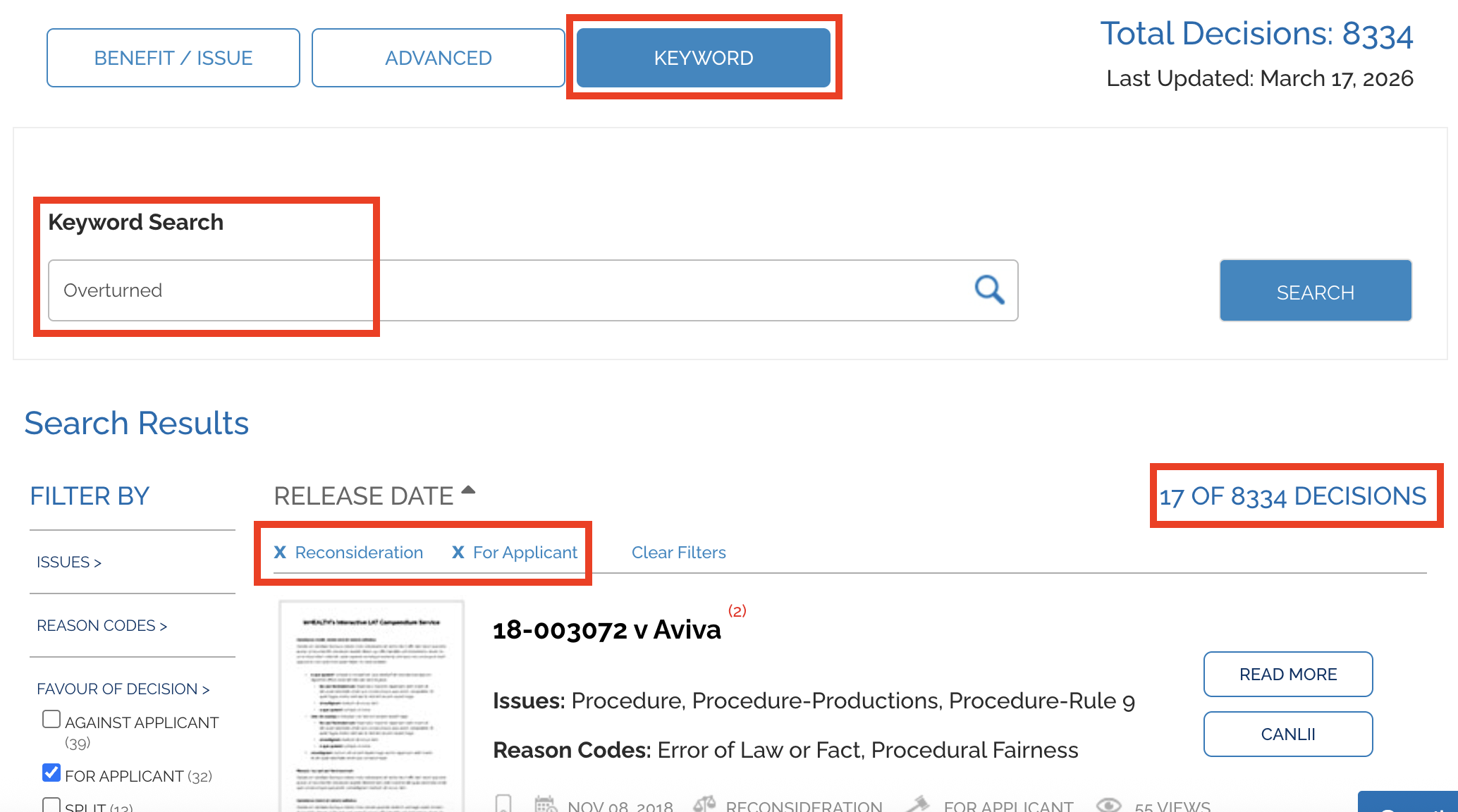
1. Go to Keyword Search and enter: Overturned (Returns 84 Decisions)
2. Filter By: Case Type – Reconsiderations (Returns 49 Decisions)
3. Filter By: Favour of Decision – For Applicant
4. Total Results 17 decisions on inHEALTH’s LAT Compendium
Marcelo v Personal Insurance: The Appellant’s appeal was allowed, and the Tribunal’s finding that an intracranial brain contusion is a minor injury was overturned. The Court found the definition of minor injury in s.3(1) of the Schedule is an injury-based definition, as opposed to the catastrophic definition in s.3.1, which is impairment-focused. It found it illogical that an injury that can satisfy the criterion for a CAT impairment could also be considered minor. It found that classifying potentially serious injuries as minor based on the level of impairment suffered would undermine the legislative choice to have a clear set of injuries that were to be dealt with pursuant to a separate regime, which could lead to uncertainty and inconsistency.
24-003339 v Allstate: The Applicant’s request for reconsideration was granted, and the decision that she was barred from proceeding with her claim because she did not provide notice to the insurer pursuant to s.32(1) of the Schedule, was overturned. Vice-Chair Moore found that he had erred and breached procedural fairness by considering the steps she may have taken to notify the Motor Vehicle Accident Claims Fund, when the narrow issue set out in the CCRO was whether she failed to notify the Respondent, the driver’s insurer.
Don’t miss key LAT decisions on sufficient notice inHEALTH’S SABS Experts are here to help – Connect on Live Chat!
Spotting MIG Risks In Clinical Notes
Sign up for a free Trial to inHEALTH’s LAT Compendium:
1. Go to Keyword Search and enter: disc protrusion
2. Filter By: “Issues”: MIG
3. Filter By: Favour of Decision – For Applicant
4. Total Results 2 decisions on inHEALTH’s LAT Compendium
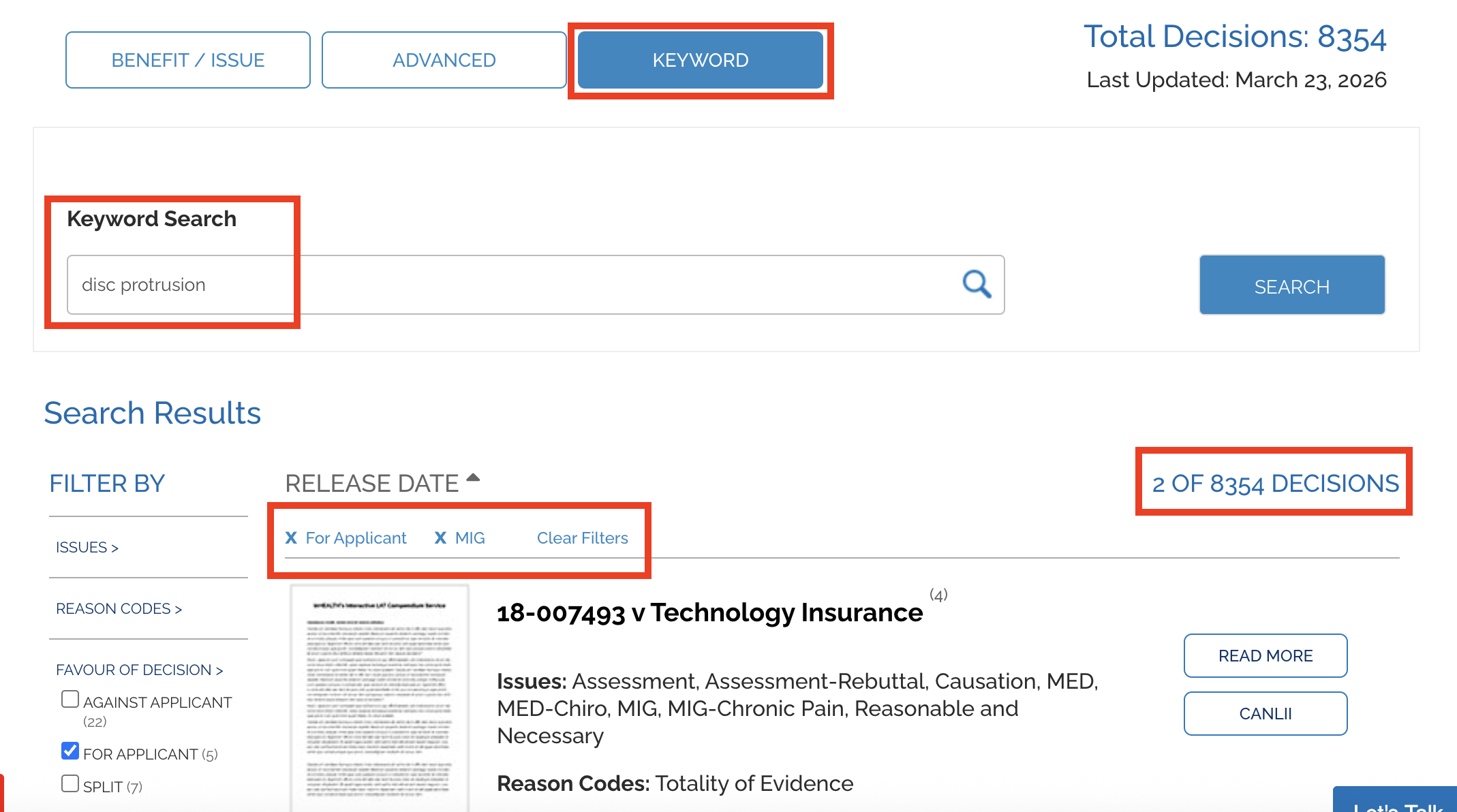
18-007493 v Technology Insurance: Additionally, the Applicant’s physical injuries were found to be non-minor, as the two MRIs of the Applicant’s cervical and lumbar spine indicated canal stenosis and disc protrusion. Since the Applicant had no pre-existing conditions and there was no intervening cause for these injuries but for the MVA, the Tribunal disagreed with the Respondent’s argument that the Applicant’s disc protrusion was not related to his accident.
24-004785 v TD Insurance: In addition, all three assessors agreed that the Applicant was suffering from a T1–T2 herniated disc, for which they prescribed medications and recommended surgery if there was no improvement over time. Dr. Karmy also noted impairments affecting sleep and mood and her limitations in her ability to work, perform housekeeping tasks, and engage in pre-accident social and recreational activities.
inHEALTH’S SABS Experts help you find the right decisions! Reduce research time with an Outcome Research Report
When does Surveillance Matter in CAT Decisions?
Q: What role has surveillance played in CAT determinations under Criterion 8 (Marked Impairment) over the past 2 years?
If you’re preparing a risk assessment for a particular matter or simply trying to understand how surveillance evidence is weighed in CAT decisions, inHEALTH’s LAT Compendium can help you locate the relevant cases quickly.
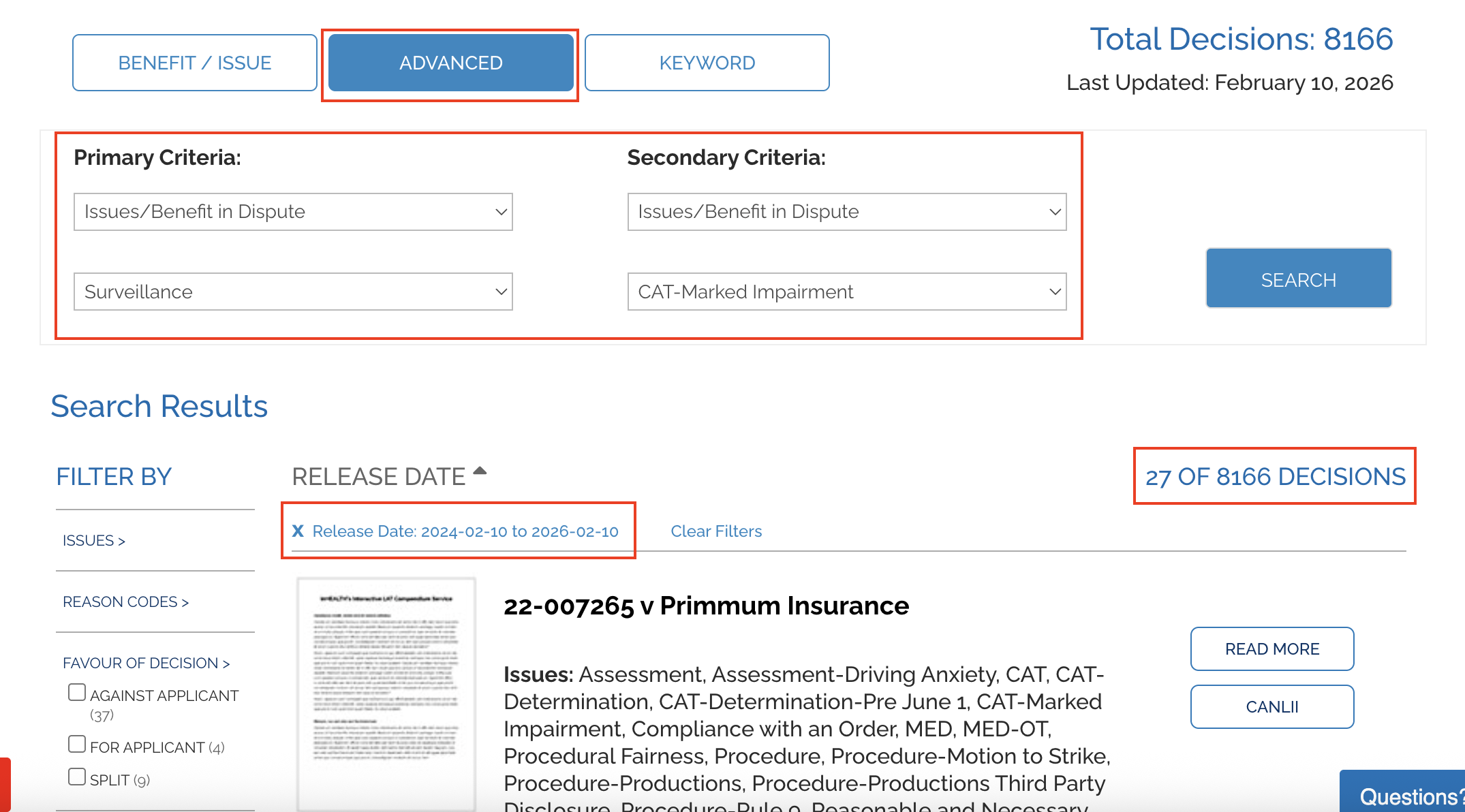
Using our Advanced Search’s “Primary” and “Secondary” Criteria, you can find all decisions where both Surveillance and CAT-Marked Impairment were considered as part of the determination.
To get just the decisions from the last two years, filter your results using the “Release Date” filter.
inHEALTH’s STAT report provides further analysis by summarizing how often surveillance was a decisive factor, as opposed to being noted but ultimately given limited weight.
TIP: Start broad with the Surveillance tag, then review outcomes before reading individual reasons. The “Favour of Decision” filter shows how the decisions are broken down.
Sign up and Login to inHEALTH’s LAT Compendium:
1. Go to Advanced Search and select: Primary Criteria “Issues/Benefit in Dispute”: Surveillance
Secondary Criteria Select “Issues/Benefit in Dispute”: CAT Marked Impairment
2. Total Results 46 decisions on inHEALTH’s
3. Filter results by “Release Date”: February 10, 2024 to February 10, 2026
4. Total Results 27 decisions on inHEALTH’sLAT Compendium
5. Filter results by “Favour of Decision”:
Against Applicant: 19 decisions
For Applicant: 2 decisions
Split: 6 decisions
For Applicant – 22-008237 v Economical: The Applicant was subject to 23 days of surveillance, yet the evidence captured demonstrates a low level of activity. On one occasion, the Applicant was observed to moving a mattress (with help from others) to his brother, who was terminally ill, on another occasion the Applicant was observed maneuvering a cargo trailer on a driveway, and on another occasion, he was observed moving/loading a dock at a vacation property with assistance from others. These observations are consistent with the Applicant’s reports that he can do occasional physical activity but is laid out thereafter. None of the surveillance footage shows the aftermath of the Applicant’s physical activity.
Against Applicant – 23-002146 v Wawanesa: Adjudicators Beauchesne and Yong placed weight on the Respondent’s 2019 surveillance evidence that tied together a five-year span of social functioning that did not support CAT impairment owing to a mental or behavioural disorder. The video evidence showed the Applicant engaged in a family dynamic that bore no hallmarks of impaired social functioning such as angry behaviour, frustration, altercations, or interpersonal difficulties.
Can NEBs Ever be Claimed Before an OCF-3?
Q: Are there any circumstances in which the Tribunal will allow an NEB claim for a period before an OCF 3 is submitted?
To advance a claim for specified benefits, a completed Disability Certificate (OCF-3) is required. Section 36(3) of the SABS does not provide an exception:
“An applicant who fails to submit a completed disability certificate is not entitled to a specified benefit for any period before the completed disability certificate is submitted.”
Use inHEALTH’s LAT Compendium’s SABS-specific filters to find cases interpreting section 36(3) and quickly see how the Tribunal has applied this requirement.
TIP: Reference Case/Legislation filters cases that involve interpretation of specific SABS references.
Sign up and Login to inHEALTH’s LAT Compendium:
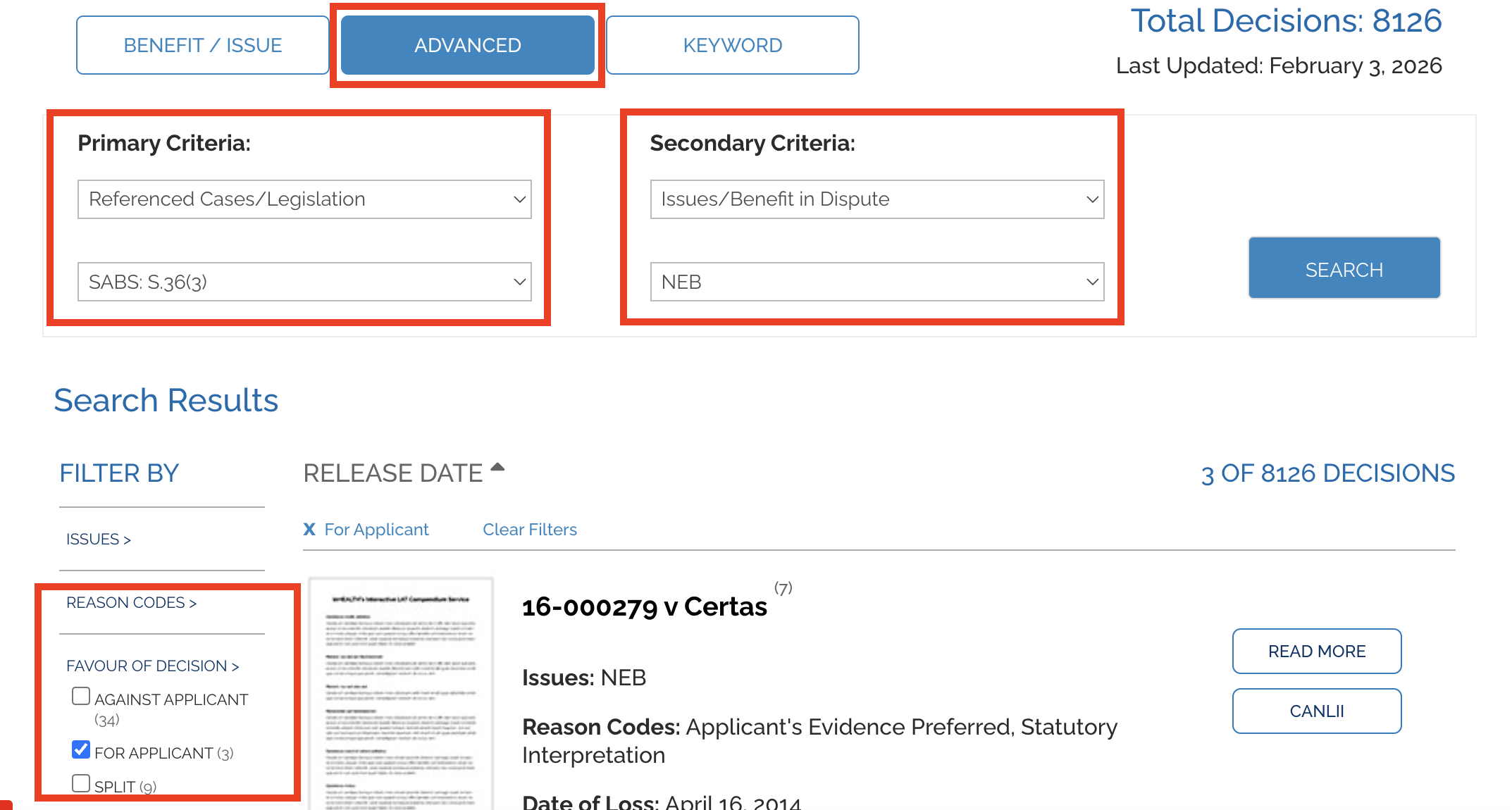
1. Go to Advanced Search and select: Primary search – Reference Cases/Legislation- s36(3) with Secondary search – Issues/NEB
2. Total Results 46 decisions on inHEALTH’s
3. Filter results by “Favour of Decision”: For Applicant
4. Total Results 3 decisions on inHEALTH’s LAT Compendium
Clouthier v. Co-Operators: The Court found that the fact that s.36(3) does not provide for exceptions or make explicit reference to a specific period of time was not, by itself, evidence of a clear legislative intent to invoke an absolute and rigid prohibition of payment benefits before the submission of an OCF-3. It found that s.36(3) must be viewed along with s.34. Section 34 is a general provision that excuses compliance with “time limits,” and it explicitly applies to all provisions in Part VIII of the Schedule, including s.36. The Court found that s.34 explicitly provides the very type of remedy that is at stake in a situation like this (where an insured is incapacitated and cannot complete an OCF-3).
inHEALTH’s Live Chat SABS Experts offer fast, effective search strategies. Chat with us now!
Certified PSW Isn’t Enough
Q: If a certified PSW wasn’t working as one at the time of an accident, can they still be compensated for the value of their services?
The “incurred expense” definition under the SABS creates a high bar for reimbursement. Specifically, sections 19(4) and 3(7)(e)(iii) dictate that if a provider isn’t providing care in their ordinary course of employment, the benefit is limited to the provider’s economic loss while providing the care.
One way to find if the Tribunal has addressed this question is to look for cases that discuss both whether an attendant was working in the course of their employment and whether they sustained an economic loss.
Using inHEALTH’s LAT Compendium, combine our “Attendant Care-Service Provider” and “Attendant Care-Economic Loss” filters, using our Advanced Search.
TIP: Use the Advanced Search’s Primary and Secondary Criteria to combine filters from the start.
Sign up and Login to inHEALTH’s LAT Compendium:
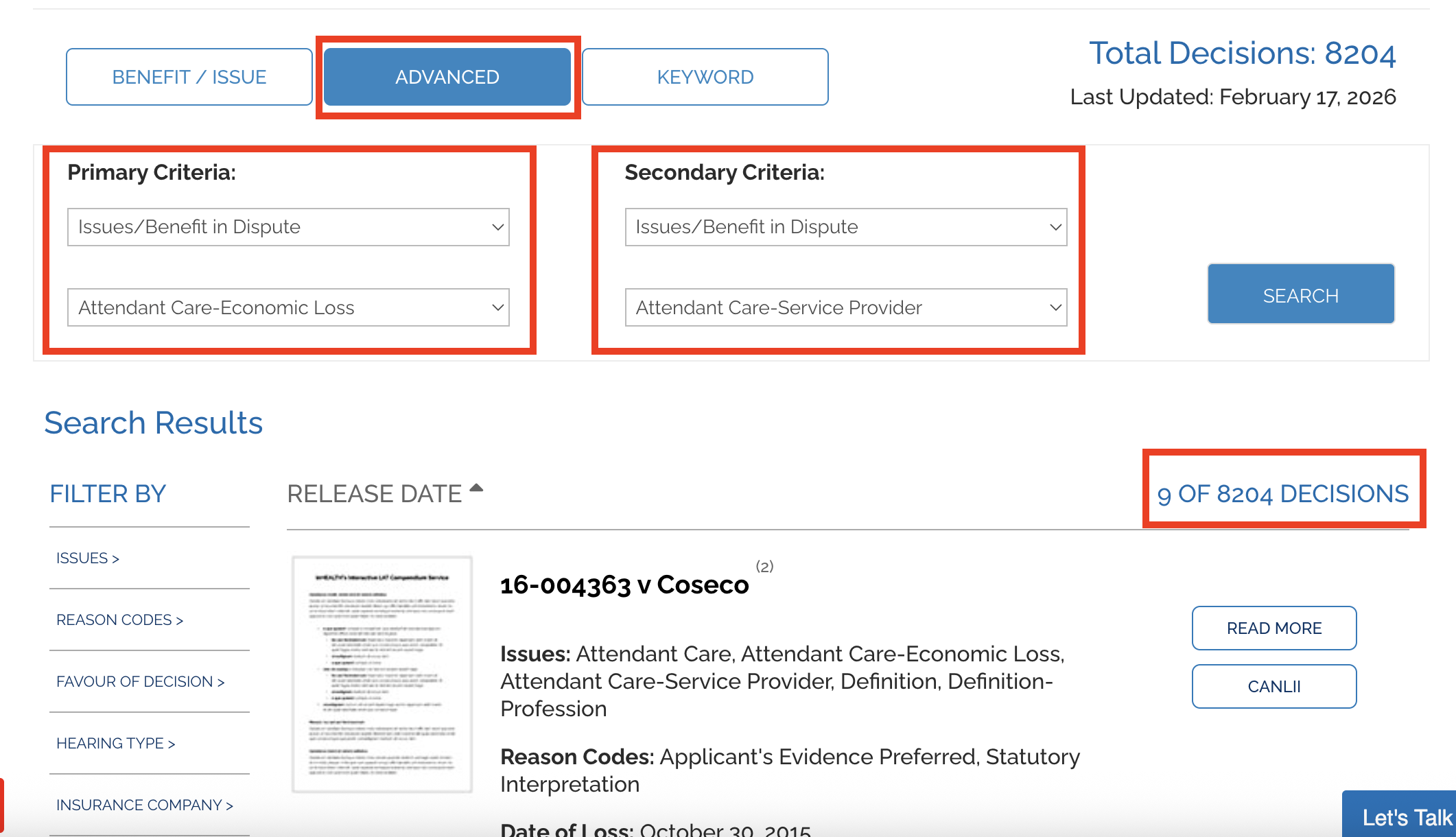
1. Go to Advanced Search and select: Primary Criteria “Issues/Benefit in Dispute”: Attendant Care-Economic Loss
2. Select Secondary Criteria: “Issues/Benefit in Dispute”: Attendant Care-Service Provider
3. Results 9 decisions on inHEALTH’s LAT Compendium
16-004363 v Coseco: The Applicant’s mother, a certified PSW, was determined to be a professional service provider under the Schedule, as, although she was not employed in that capacity at the time of accident, she was actively seeking employment and subsequently found a position 10 months after the accident. In determining whether she qualified as a professional service provider, the Tribunal held that her relation to the Applicant was not a factor, and that being designated a professional is not dependent on employment, but on “training, competency, any required professional/regulatory certification” and whether the individual is “actively trying to obtain employment in the profession”. Having found that the Applicant’s mother was actively looking for employment at the time of the accident, she does not need to prove economic loss and can charge for her services at the professional rate.
17-000848 v Echelon: The Applicant is entitled to the claimed ACB expenses performed by Ms. Salazar. Although the Respondent claimed Ms. Salazar was not a professional service provider under the Schedule because she was not employed in that capacity at the time of the accident, the Tribunal concluded that the Schedule does not state that a provider must be exclusively employed as a health professional in order to be considered as such. As Ms. Salazar was certified as a PSW, last worked in the capacity in 2013, and subsequently found work as a PSW after aiding the Applicant, the Tribunal determined she was a professional service provider, and that her services were performed “in the course of the employment, occupation or profession in which they would ordinarily have been engaged, but for the accident”. Therefore, she did not need to demonstrate economic loss.
Navigating the complexities of concussion claims? inHEALTH’s Outcome Analysis Reports (OAR) provide concise, case-based insights for your risk assessment. Contact us – ‘I need a paddle’.
Tuesday Tips Archive
Let inHEALTH’s Experience Work for You
With 6,000+ LAT decisions reviewed, indexed, summarized – We know stuff.

LAT Compendium
LAT Decision Database, Newsletters & Live Chat

Research
Report
Outcome Analysis Report (OAR)

CARS
Resolution
Claim Assessment and Resolution Services

Training Programs
SABS & BI
Fundamentals

Statistical Reports
Analysis on success rates at the LAT
Our Team Is Here To Help!
1
Select your
service
2
Ask your question

3
Our Team provides answers

Get Started here