

Complimentary Issue – September 23, 2026
In February 2025, we covered the Divisional Court’s ruling in Hussein v. Intact, where the Court prioritized consumer protection principles and placed a positive obligation on insurers to inquire about injuries following an accident report.
The Ontario Court of Appeal (COA) has now overturned that decision, holding that the Divisional Court erred by straying from the plain language of s. 32(1) of the SABS.
Virtual Training – New Sessions Added!

Secure your seat for inHEALTH’s 2025 upcoming Virtual Training sessions!
- SABS Expedited: September 28 – October 2, 2026
*Eligible Participants receive 9 Substantive – CPD hours upon course completion
Course details & register here +
COA Sets Aside Divisional Court Ruling on S.32 Notice Requirements
COA Flips Court re Notice Obligations – Hussein Jakupovic was involved in a motor vehicle accident on February 13, 2019. He contacted his insurer Intact the following day and reported the accident and the property damage to his vehicle. While he had contact with Intact on multiple occasions concerning the property damage, he did not advise them of his intention to claim accident benefits until December 12, 2020, when he submitted an Application for Accident Benefits (OCF-1) to them. Intact had initially approved the application for benefits but later raised the issue of whether the claim was statute-barred. They subsequently notified Jakupovic that they were terminating his entitlement to benefits on April 14, 2022 due to late reporting.
Dispute History
Jakupovic then applied to the LAT for dispute resolution in December 2022, wherein the LAT determined that Jakupovic failed to comply with section 32(1) of the SABS because he failed to notify Intact within seven days of his intention to claim accident benefits. In a subsequent reconsideration, this decision was upheld. Jakupovic then appealed the LAT decisions to the Divisional Court. In a decision dated February 7, 2025, the Divisional Court allowed the appeal, finding that by reporting the accident, Jakupovic had complied with s. 32(1) of the SABS. In Jakupovic v Intact, Intact appeals the decision of the Court.
The Divisional Court erred in its interpretation of s. 32(1)
The Court of Appeal (COA) cited a recent Supreme Court decision that affirmed “It is the meaning of the provision of the statute and its clarity that is at issue, informed by its text, context and purpose”. In other words “courts are not to adopt meanings that are at odds with the actual language of the statute.” Further citing a recent decision of the Federal Court of Appeal, “policy considerations cannot be permitted to distort the actual words of the statute, read harmoniously with the scheme of the statute, its object, and the intention of the legislature, so as to make the provision say something it does not.”
For their part, Intact submitted that “s. 32(1) of the SABS is not ambiguous and that the interpretation of the Divisional Court is wrong in law and departs from the plain meaning of the section. It imposes obligations on insurers that are not contained in the statute and reverses the sequence of the steps that the legislature enacted”. Jakupovic on the other hand contended that “the Divisional Court’s interpretation aligns with existing jurisprudence and the general principles of statutory interpretation. The provisions of the SABS must be interpreted through the lens of consumer protection legislation”. As intervenor, OTLA supported Jakupovic’s position, suggesting “that a duty of good faith is owed by insurers to their insureds and that upon being notified by the insured of an accident, there is an obligation on the insurer to make inquiries to ascertain if the insured was injured and if so, to provide the application forms to commence the process. OTLA says that reporting an accident is sufficient to comply with s. 32(1), as found by the court”.
COA Weighs In
The COA however did “not agree with this interpretation. In my view, s. 32(1) is not ambiguous. It requires a person who is involved in an accident and who intends to claim benefits to notify the insurer of their intention to do so. This is plain, clear language and it is mandatory…The submission of (Jakupovic) and of (OTLA) that there is an obligation on the insurer to ask questions of the insured to ascertain if they are injured and intend to apply for benefits is without merit. It is contrary to a plain reading of s. 32(1) which requires certain action from the insured to provide notice that accident benefits will be claimed.”
Further, the COA found that “the Divisional Court erred in law by focusing its analysis on the fact that the SABS is consumer protection legislation rather than following the established principles of statutory interpretation. The Divisional Court’s analysis proceeded directly to weighing two competing interpretations in light of the purposes of the regulation, without first considering whether the text, context, and purpose read together pointed towards a clear meaning. This was an error. As the Supreme Court has noted, “even ‘laudable’ policy objectives do not themselves permit courts to apply interpretations that are not consistent with the text and context.”
The COA referenced the Court wherein it held that “T]he notice requirement under the LAT was met when the Insured advised the Insurer one day after the accident that he had been in an accident. A reasonable insurer would assume that an insured who has been in an accident intends to access all the benefits available to them under their policy… If the Insurer in this case wished to clarify which specific benefits the Insured intended to access, the Insurer could have asked the Insured whether he sustained any injuries. As the Insurer chose not to ask any more questions, it should have acted on the assumption that the Insured would want to apply for accident benefits. At that point, the Insurer should have complied with its obligations under s. 32(2) of the SABS, which included sending out the necessary application forms and an explanation of the benefits available. This is an interpretation that fosters the consumer protection purpose of the SABS.”
However, the COA cited this as an error, “by rewriting the statutory requirements to include provisions that are not in the legislation… there was no basis for the Divisional Court to conclude that s. 32(1) requires an insurer once notified of a motor vehicle accident involving its insured to assume that an insured will be making a claim for SABS. Simply put, s. 32(1) does not say this. The Divisional Court’s interpretation would equate reporting involvement in a motor vehicle accident with reporting injuries and an intention to claim SABS. If the legislature meant that simply reporting involvement in an accident was sufficient notice to an insurer that a claim for SABS was being made, it could have said that.” In addition, there was “nothing in the words used by s. 32(1) that places an onus on the insurer to inquire of an insured if they will be submitting a SABS application in order to start the process of benefit payments.”
Get Your Stats Report!
inHEALTH’s Statistical Reports provide insights and analysis on the outcomes of Licence Appeal Tribunal (LAT) and court decisions.
Customize success rate reports on any variable relating to disputed AB claims captured in LAT and court decisions!
Decisions By Top 10 Insurers
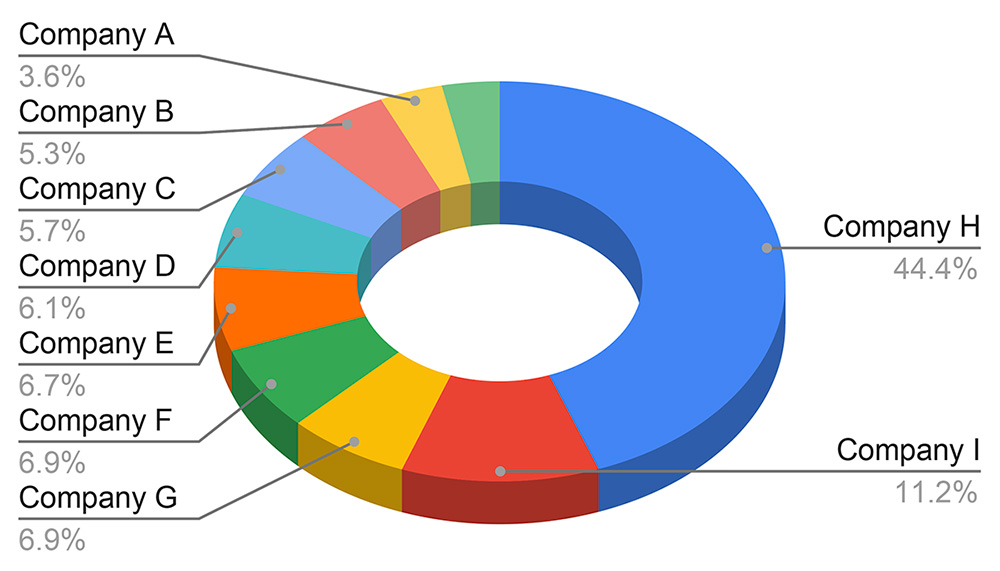
*Sample Chart
Statistical Report fees are based on the complexity of your data request
Learn More & Get a Quote Here >
Incorrectly Finding Its Own Facts
The COA further found that the Court erred by exceeding the scope of proper appellate review and finding its own facts. The Court had determined that:
- The notice period of seven days was “a very short notice period”,
- Claimants who have been injured “are in a vulnerable position”, and
- “The average consumer would [not] be familiar with the entitlement to damages and the role of the SABS”.
Accordingly, the Court had wrongly “substituted its own factual findings for those of the LAT, finding the respondent did not understand his entitlement to SABS. These broad, generalized statements were not contained in the evidentiary record before the Divisional Court and it was incorrect for the court below to make these findings and to rely on them in their analysis.” The Court had also referenced medical evidence that post-dated the decision of the LAT, which was found to have been procedurally unfair, exceeding the proper scope of appellate review in the matter.
Disposition
Therefore, the COA allowed the appeal and set aside the decision of the Divisional Court dated February 7, 2025, restoring the decision of the LAT dated December 22, 2023, and the Reconsideration decision dated May 21, 2024. Costs to Intact in the sum of $10,000 all inclusive were awarded, and the earlier costs award of the Divisional Court was set aside.
Inform your position & present persuasive arguments. Include an Outcome Analysis Report (OAR) in your case evaluation complete with For/Against cases. Get an OAR – Available as a fee for service.
inHEALTH Keeps you LAT inFORMED With Access To:
1. LAT Compendium Database – a relational database of LAT and Divisional Court Decisions equipped with multiple search options, Smart Filters, and concise case summaries
2. Notifications: – weekly LAT inFORMER delivered to your inbox Wednesdays; Newly Added Decisions on Fridays and Breaking News as and when it happens
3. Research Support: – inHEALTH’s Live Chat Experts for guided searches and technical inquiries.
Sign up for a 14 day free trial below to experience the service and see how it can help guide your decision making.