

Volume. 10 Issue. 33 – November 18, 2026
In The Spotlight
Following the Court of Appeal’s decision in Jakupovic, the Tribunal was tasked with determining whether an Applicant had a reasonable explanation for a four-month delay in reporting injuries to the Respondent. Complicated by two unreported prior MVAs, the case ultimately turned on the central issue of the Applicant’s diminished capacity.
Advanced LAT Search Strategies and Best Practices
Our Search Strategy Best Practices offers a helpful framework for structuring these multi-layered queries – book your one on one orientation or register for our next webinar on December 1 at 1 PM to learn how & get your CPD hours.
Session Details:
- Date & Time: Tuesday, December 1, 2026, at 1:00 PM EST
- What We’ll Cover: 4-step search best practices, database structure optimizations, and high-value workflow shortcuts (including Live Chat and Outcome Analysis Reports).
- CPD Credit: Qualifies for 1 Substantive CPD Hour.
Multiple MVAs, Diminished Capacity and Late Notice

Reasonable Explanation
This matter was complicated by the fact that JD was in two alleged prior accidents (on April 21, 2022, and January 22, 2023) and he did not report these accidents to The Commonwell until after the subject accident. The first accident occurred when a deer ran out from a ditch and struck the driver’s side door of JD’s vehicle. The second accident occurred when JD lost control of his vehicle on the icy highway causing the vehicle to roll onto its roof. There was no evidence that accident benefits had been sought in either of the prior accidents.
With respect to the subject MVA, the adjusters’ log notes confirm that the PoA contacted The Commonwell the day following the accident, on August 22, 2023. The log notes of this day indicate that upon asking the PoA whether JD sustained any injuries, she responded ‘no’ (i.e., “Injuries: – None”). There was no evidence of any further communication between JD (or his PoA) and The Commonwell after this until December 28, 2023. On that date, the PoA contacted The Commonwell by email to advise that JD was experiencing symptoms which she believed to be from a concussion “since he has had 2 accidents”. The PoA reported that JD was having difficulty communicating, was experiencing cognitive issues and high anxiety. She advised that JD was under his physician’s care and that he could no longer work. The PoA requested a “form from the insurance company” to get JD “some rehab to get his memory back.”
During a subsequent January 2, 2024 call, The Commonwell was advised that JD underwent a CT scan at the Bracebridge hospital and that the results of a second CT scan completed in Lindsay were pending. The notes indicate that JD’s family physician wants him to attend a concussion clinic and his current complaints include: “word finding issues; difficulty making decision; wandering at work; lack of focus; and not following logical steps like before.” When asked why he did not notify The Commonwell of his injuries earlier, the notes state that “it never occurred to him; his sister reached out.”
Finally, on January 10, 2024, JD submitted his OCF-1, claiming benefits for the subject accident. In response, The Commonwell advised JD that he was in breach of section 32(1) of the Schedule and it requested of him a reasonable explanation for the delay in notifying it of his intention to claim accident benefits. Following two follow up requests, counsel for JD, on April 4, 2024, indicated that he had been retained. However, it was not until February 19, 2025, nine months later, JD’s counsel wrote, in part:
I am writing to clarify my client’s position in response to the alleged delay in submitting the application. On August 21, 2023, [the applicant] notified [the respondent] of his involvement in a motor vehicle accident and his intention to apply for benefits under [the Schedule]. Pursuant to Section 32(2) of [the Schedule], the insurer was required to provide the necessary application forms in a timely manner however, failed to do so. Only after further follow-ups did the Insurance company provide the forms on December 29, 2023, some four months after the accident. To maintain my client’s position, I will refer you to [Hussein], a recent Divisional Court decision that emphasizes the consumer protection purpose of [the Schedule] and highlights the responsibilities of insurers…”.
Virtual Training – Upcoming Dates!

Secure your seat for inHEALTH’s 2026 upcoming Virtual Training session!
Advanced LAT Search Strategies and Best Practices
Our Search Strategy Best Practices offers a helpful framework for structuring these multi-layered queries – book your one on one orientation or register for our next webinar on December 1 at 1 PM to learn how & get your CPD hours.
- Date & Time: Tuesday, December 1, 2026, at 1:00 PM EST
- What We’ll Cover: 4-step search best practices, database structure optimizations, and high-value workflow shortcuts (including Live Chat and Outcome Analysis Reports).
- CPD Credit*: Qualifies for 1 Substantive CPD Hour.
*Eligible Participants receive 9 Substantive – CPD hours upon course completion
In his additional submissions following the Court of Appeal’s decision in Jakupovic, JD resiled from any submission that there is an obligation on the insurer to ask questions of the insured to ascertain if they are injured and intend to apply for benefits. However, he submitted “that this matter is sufficiently distinguishable from Jakupovic, both factually and legally, as there was no issue of mental incapacity in Jakupovic whereas here, mental incapacity is the central issue. He argues that he is a cognitively disabled elderly man, left to his own devices to suffer in silence without any capability to understand what he needed to do to advance his rights to statutory accident benefits. He further submits that his sister acted with the best of intentions but had no binding legal authority in this regard. He argues that the respondent received notice of his intention to apply for accident benefits as soon as practicable within the meaning of section 32(1).”
Ultimately, the Tribunal found that JD did not notify The Commonwell of his intention to apply for accident benefits within seven days of the accident. At issue therefore being whether JD provided a reasonable explanation for his delay. For their part, The Commonwell submitted that JD’s explanation is not credible, relying on Ilangeswaran v. Sonnet Insurance, where the Tribunal found that the applicant’s explanation that her injuries were latent and developed as time passed was not credible.
The Tribunal however referenced CNRs from JD’s family physician. The CNRs reflected that JD “was diagnosed with residual cognitive deficits following concussions he sustained after two motor vehicle accidents in January and then August 2023. The reason diagnosis took so long (it was January 2024 before he got a proper diagnosis) is that the impairments from the initial motor vehicle accident in January 2023 were subtle, such as mild forgetfulness and brain fogginess. It was after the second MVA, in August 2023, that he really had a decline in his cognitive function and began making mistakes at work, such as cutting the wrong flowers at the garden centre he was working at, “spacing out”, wandering off to the road, and replacing equipment in the wrong spot. It was only after he was let go from his job that his family became aware that there was something wrong, as he lives alone and didn’t have anyone around him on a daily basis to notice the subtle differences in his cognition, memory and behaviour. (…) In fact, I was not made aware of the first MVA in January 2023 until AFTER his accident in August of 2023 when he had a steep decline in his function and was let go from his job.”
The Tribunal found that the consultation notes show that JD’s impairments became more apparent as time went on but that, “as per the note of October 2, 2023, there remained the question of whether it was due to a concussion sustained in the accident or some other underlying impairment. I am satisfied that the medical evidence submitted provides a reasonable explanation for the applicant’s delay in notifying the respondent. I find that the applicant was not in a position to appreciate his impairments following the accident or to communicate them effectively to his PoA. I am also satisfied that the PoA notified the respondent of the applicant’s cognitive impairments “as soon as practicable” and advised it of further scheduled testing which ultimately led to the diagnosis of a concussion. I do not accept the respondent’s argument that the applicant’s capacity, or lack thereof, at the time of the subject accident has no bearing on this preliminary issue.”
Concluding, the Tribunal found that “objectively, subjectively, and based on the medical evidence submitted, the applicant’s cognitive impairments affected his ability to appreciate his impairments following the subject accident. I also find, as per his family physician’s consultation letter of February 13, 2024 and her consultation notes, that the applicant’s PoA was not immediately aware of his impairments since the applicant lived alone, and once she observed issues, a question remained as to whether the impairments were due to the accident or to another underlying issue.”
Further, “that the timing of the PoA’s notification to the respondent was reasonable and that the delay was not significant. I find that the evidence supports the PoA notified the respondent of the applicant’s intention to claim accident benefits as soon as the impairments became known. The PoA notified the respondent of the various impairments in her December 28, 2023 email, at a time she suspected a potential concussion and the applicant was being sent for further testing. Contrary to the respondent’s submissions, I do not find a four-month delay to be “egregious” or “substantial” in the circumstances of this case.”
With respect to The Commonwell’s submission that it was prejudiced by the delay, the Tribunal reiterated that a four-month delay was not significant, and that any prejudice does not relieve against the potential hardship to the applicant. Any prejudice was “outweighed by the severe hardship that could result to the applicant should the application be barred without a determination on its merits.” Acknowledging the potential challenges to JD’s claims that are posed by the two previous accidents, it was noted that the parties will still have opportunity to argue this question in the context of his entitlement to the benefits he claims at the substantive hearing. Accordingly, JD had provided a reasonable explanation for his delay in notifying The Commonwell and was allowed to proceed with his application.
Get Your Stats Report!
inHEALTH’s Statistical Reports provide insights and analysis on the outcomes of Licence Appeal Tribunal (LAT) and court decisions.
Customize success rate reports on any variable relating to disputed AB claims captured in LAT and court decisions!
Decisions By Top 10 Insurers
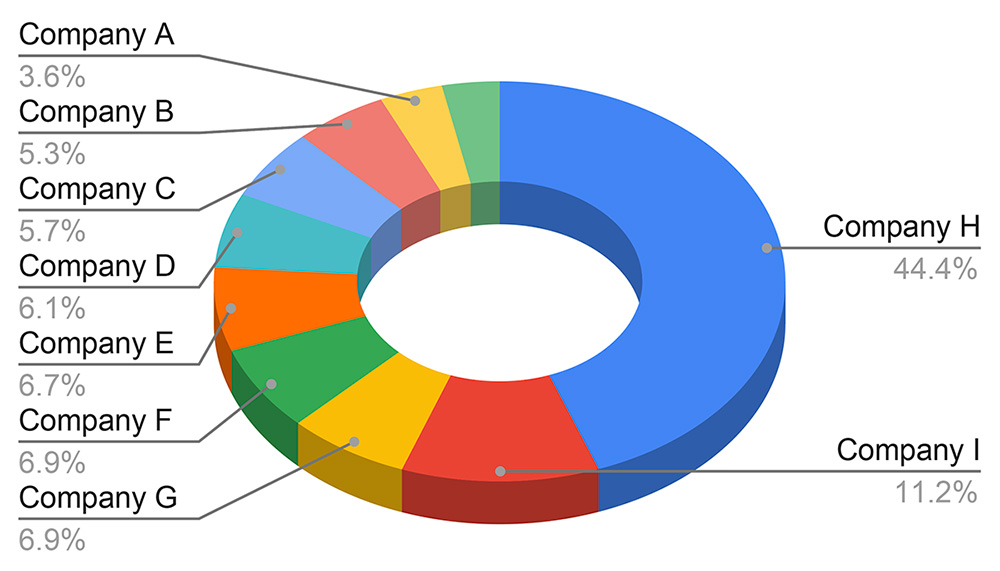
*Sample Chart
Statistical Report fees are based on the complexity of your data request
