

Volume. 10 Issue. 32 – November 11, 2026
In The Spotlight
The Court of Appeal recently set aside an application judge’s refusal to approve an AB settlement for a party under disability. In doing so, the Court corrected several legal errors regarding jurisdiction and confirmed that deciding a matter on unraised grounds without giving the parties notice or an opportunity to respond is a breach of procedural fairness.
Advanced LAT Search Strategies and Best Practices
Our Search Strategy Best Practices offers a helpful framework for structuring these multi-layered queries – book your one on one orientation or register for our next webinar on December 1 at 1 PM to learn how & get your CPD hours.
Session Details:
- Date & Time: Tuesday, December 1, 2026, at 1:00 PM EST
- What We’ll Cover: 4-step search best practices, database structure optimizations, and high-value workflow shortcuts (including Live Chat and Outcome Analysis Reports).
- CPD Credit: Qualifies for 1 Substantive CPD Hour.
Register for the Upcoming Webinar
Court of Appeal Rules on Settlement

COA Approves $70K Settlement
This week sees the Court of Appeal dealing with an AB matter, in Borok v Primmum. Specifically, the appeal concerned the approval of a proposed settlement for a party under disability. An application record was submitted to the court and assigned to the application judge to review. The appellant insurer consented to the approval of the proposed settlement. However, the application judge dismissed the request for approval. Without hearing submissions from the parties, on his own initiative, he determined that the Superior Court of Justice did not have jurisdiction to approve the proposed settlement because it involved the resolution of claims under the Statutory Accident Benefits Schedule, which was the exclusive jurisdiction of the Licence Appeal Tribunal (“LAT”).
Jurisdiction for Disputes
The insurer appealed to the court, submitting the application judge erred in law in his analysis of the jurisdiction of the Superior Court. The respondent and the interveners agree that the decision must be set aside. The parties further requested that the court approve the proposed settlement. At the hearing of the appeal, the appeal was allowed and the court approved the proposed settlement with reasons to follow. The court found that “the decision of the application judge is fundamentally flawed, and he erred in several ways in his understanding of s. 280 of the Insurance Act, R.S.O. 1990, c. I.8 and r. 7.08 of the Rules. In addition, the manner in which he dealt with the application for approval was procedurally unfair.”
The court found that the application judge misunderstood s. 280 of the Insurance Act, finding that the LAT had “exclusive jurisdiction” over all things related to SABS, including a proposed settlement, which was not what the section says. Rather, section 280 of the Insurance Act deals with the procedure to be followed when there is a dispute concerning an insured person’s entitlement to a benefit or the quantum of a benefit. When it was enacted in 2016, s. 280 removed the right to sue in the Superior Court for disputed entitlement to SABS and conferred on the LAT exclusive jurisdiction to determine these disputes.
Virtual Training – Upcoming Dates!

Secure your seat for inHEALTH’s 2026 upcoming Virtual Training session!
Advanced LAT Search Strategies and Best Practices
Our Search Strategy Best Practices offers a helpful framework for structuring these multi-layered queries – book your one on one orientation or register for our next webinar on December 1 at 1 PM to learn how & get your CPD hours.
- Date & Time: Tuesday, December 1, 2026, at 1:00 PM EST
- What We’ll Cover: 4-step search best practices, database structure optimizations, and high-value workflow shortcuts (including Live Chat and Outcome Analysis Reports).
- CPD Credit*: Qualifies for 1 Substantive CPD Hour.
*Eligible Participants receive 9 Substantive – CPD hours upon course completion
Course details & register here
The application judge erred in law by concluding that s. 280 granted the LAT exclusive jurisdiction over all matters relating to SABS, including the approval of proposed settlements. However, in fact section 280 grants exclusive jurisdiction to the LAT over disputes arising from ongoing claims related to SABS, not to settlements. Section 280 of the Insurance Act does not address proposed settlements of SABS claims for parties under disability.
The court described how “the requirement for court approval of settlements made on behalf of parties under disability is derived from the court’s parens patriae jurisdiction. The parens patriae jurisdiction is of ancient origin and is “founded on necessity, namely the need to act for the protection of those who cannot care for themselves…to be exercised in the ‘best interest’ of the protected person…for his or her ‘benefit or welfare’.” In the present matter, the application judge misunderstood the purpose of r. 7 and the parens patriae jurisdiction of the court. The court has confirmed on numerous occasions that r. 7.08 provides that no proposed settlements on behalf of parties under disability are binding without a judge’s approval.
A paralegal can negotiate a resolution of a claimant’s SABS claims
The application judge further erred in finding that a lawyer must negotiate the proposed settlement for the party under disability and file an affidavit confirming this. The application judge found he “could not approve the settlement without requiring Mr. Borok to renegotiate his settlement with a lawyer acting for him.” However, “ Rule 7 does not require a lawyer to participate in the settlement negotiations for a party under disability; it simply requires that as part of the material filed in support of the approval motion or application, an affidavit of solicitor acting for the litigation guardian be filed. This affidavit must set out the lawyer’s position in respect of the settlement. The application judge’s finding in this regard was incorrect. There is no prohibition against paralegals who are licensed by the Law Society of Ontario dealing with SABS claims on behalf of clients who are under a disability.”
There was procedural unfairness
Further, the “the application judge failed to advise the parties that he was considering dismissing the approval application on the basis that the Superior Court lacked jurisdiction. Instead, he convened an oral hearing because of concerns he had about a paralegal negotiating a proposed settlement of a claim for SABS on behalf of a party under disability, and with the lawyer swearing the affidavit being retained after the settlement negotiations…The application judge ought to have advised the parties and the PGT that he was considering dismissing the application for lack of jurisdiction. The first notice that the parties had that the judge had a concern about his jurisdiction to approve the proposed settlement was when his reasons dismissing the application were released. It was manifestly unfair to the parties to proceed in this fashion, particularly given the fact that counsel were following the established procedure for approval of proposed settlements pursuant to r. 7.08”.
Disposition
Concluding, the appeal was allowed and the decision of the application judge set aside. The proposed settlement in the amount of $70,000 was approved, pursuant to the court’s authority regarding settlements.
Get Your Stats Report!
inHEALTH’s Statistical Reports provide insights and analysis on the outcomes of Licence Appeal Tribunal (LAT) and court decisions.
Customize success rate reports on any variable relating to disputed AB claims captured in LAT and court decisions!
Decisions By Top 10 Insurers
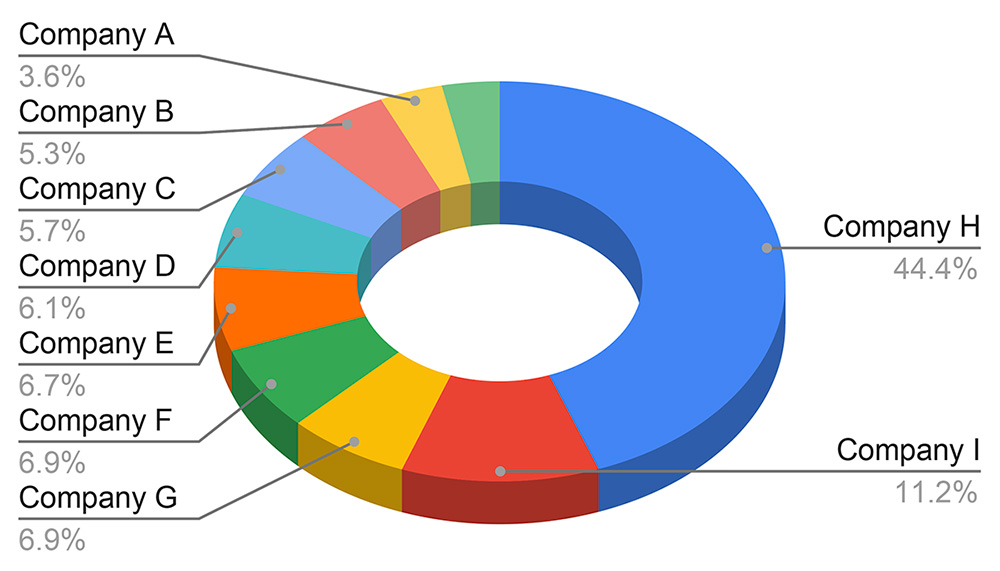
*Sample Chart
Statistical Report fees are based on the complexity of your data request
Learn More & Get a Quote Here >
