


Volume. 10 Issue. 30 – October 15, 2026
In The Spotlight
This edition covers the Tribunal conducting a rehearing addressing pre- and post-104 week IRB entitlement. Ultimately, despite considerable gaps in both pre as well as post 104 IRB entitlement, the Tribunal found that the Applicant’s post-accident functional deterioration warranted ongoing post-104 IRBs commencing nearly two years into the post-104 period.
Virtual Training – Upcoming Dates!

Secure your seat for inHEALTH’s 2026 upcoming Virtual Training session!
- TBA
*Eligible Participants receive 9 Substantive – CPD hours upon course completion
Course details & register here +
Rehearing Confirms Post 104 IRB Ongoing Despite Gaps
No to Pre 104 IRB Yes to Post 104 IRB – Injured in a June 2019 MVA, the Applicant, Kerr-Knights, appealed to the LAT for a CAT designation and ongoing IRBs. In an August 12, 2025 decision, the Tribunal found her catastrophically impaired under Criterion 8. It denied IRBs from March 2, 2021 to September 1, 2024, but awarded ongoing IRBs starting September 1, 2024. Following a January 2026 reconsideration order, a rehearing was held solely on IRB entitlement (leaving the CAT finding intact) 24-009699 v Definity details the rehearing results conducted by review of the transcripts and exhibits from the initial hearing.
Background
At the time of the accident, Kerr-Knights had just finished her first year as an undergraduate at McMaster University in a neuroscience program. She was also working as a part-time swim instructor and lifeguard. After the accident, she returned to school, but she eventually switched programs and subsequently was unable to complete university. She also returned to work a few months post-accident but stopped working around March 2020. Definity initially paid an IRB, but discontinued IRBs as of March 1, 2021, relying on multidisciplinary IE’s. Kerr-Knights made two attempts to return to other employment in 2022 but was not successful.
Pre-104 week IRBs
The Tribunal found that Kerr-Knights was not entitled to IRBs from March 2, 2021, to June 7, 2021, the remaining pre-104 week period. The Tribunal found that Kerr-Knight’s testimony, that she was unable to continue in her job as a lifeguard and swim instructor due to her accident-related impairments, was not supported by her employment file or the medical record. She testified that despite returning to work for a few months, she was unable to continue working and had been “giving away” all of her shifts. She last recalled working in October 2019, however was unsure whether she had quit or if she was fired. However, the employment file revealed that she worked her typical part-time hours until at least February 2020.
The Record of Employment shows her last day worked was March 8, 2020, coinciding with pandemic-related pool closures. In her Employment Insurance application, she stated that she stopped working due to a work shortage, was not looking for work as of September 24, 2021, and was waiting for her employer to recall her, supporting Definity’s position that her leave was not accident-related. Additionally, the Tribunal found she failed to prove her post-concussive symptoms (light/noise sensitivity and lack of focus) were caused by the accident.
The Tribunal was also not persuaded that she had fully recovered from her 2013 concussion prior to the accident, CNRs from February 2017 and October 2018 documented ongoing post-concussive symptoms. Additionally, she requested academic accommodations for an acquired brain injury in September 2018 and sought to reinstate them in May 2019, less than a month before the accident. Because her claim for pre-104 week IRBs relied on these post-concussive symptoms, she failed to prove that accident-related impairments rendered her substantially unable to perform her essential job duties from March 2, 2021 to June 7, 2021.
Post-104 week IRBs
Kerr-Knights submitted that her accident-related impairments including psychological conditions, cognitive deficits, and a traumatic brain injury caused a complete inability to work. She pointed to treating physicians’ CNRs and her hearing testimony showing a severe functional decline from 2021 to 2023, culminating in two 2024 hospitalizations for suicidal ideation. Relying on her April 2023 Section 25 CAT reports, her testimony, and Definity’s own April 2025 OT assessment, which noted significant barriers to maintaining employment, she argued that her medical record fully supports this decline.
Definity disputed any significant functional deterioration and argued that Kerr-Knights failed to meet her onus under Section 6. It noted that she provided no vocational or expert evidence for this specific test, as her expert reports focused solely on CAT Criterion 8 (adaptation). Definity emphasized that a marked impairment in adaptation does not automatically establish a complete inability to engage in any employment. Finally, Definity argued that because Kerr-Knights failed to qualify for pre-104 week IRBs, she cannot meet the higher threshold required for post-104 week benefits.
Get Your Stats Report!
inHEALTH’s Statistical Reports provide insights and analysis on the outcomes of Licence Appeal Tribunal (LAT) and court decisions.
Customize success rate reports on any variable relating to disputed AB claims captured in LAT and court decisions!
Decisions By Top 10 Insurers
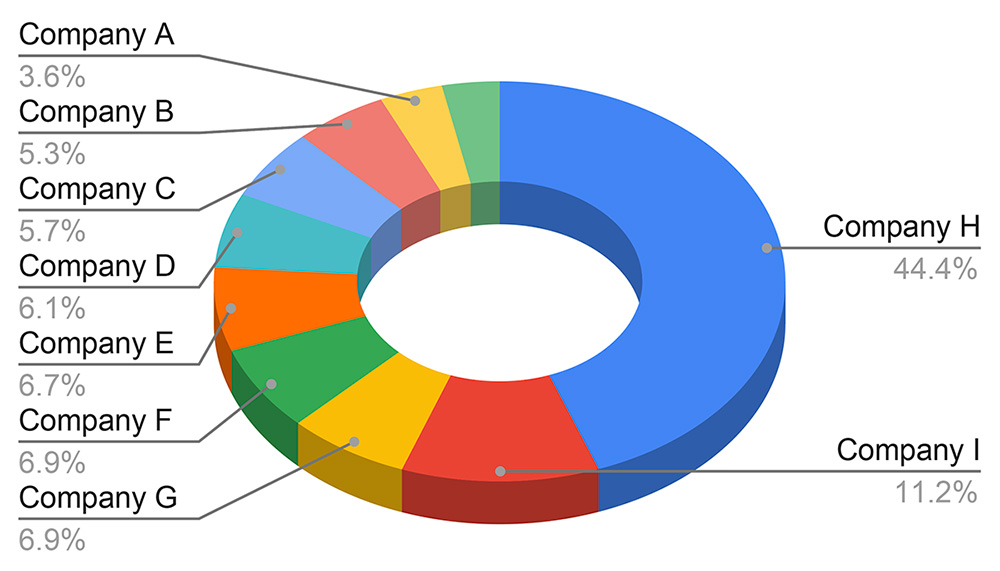
*Sample Chart
Statistical Report fees are based on the complexity of your data request
Learn More & Get a Quote Here >
Implication of the Applicant’s failure to establish entitlement to pre-104 week IRBs
In closing submissions, Definity argued that Kerr-Knights’ failure to establish entitlement to pre-104 week IRBs barred her from qualifying under the stricter post-104 week test. Relying on the Divisional Court’s decision in Paesano v. Coseco, which held that an insured must first establish pre-104 week entitlement to qualify for post-104 week IRBs, Definity maintained that her claim must fail. However, the Tribunal noted that Kerr-Knights had applied for and received pre-104 week IRBs until March 1, 2021, thereby establishing her pre-104 week entitlement, albeit for a limited period.
The Tribunal then acknowledged that Kerr-Knights had not established entitlement to post-104 IRBs until April 11, 2023, which is more than two years after the pre-104 week IRBs were terminated. However, the Tribunal found there to be compelling medical evidence to establish a significant deterioration in her function and accident-related psychological injuries between 2021 and 2023. This culminated in her being found to be catastrophically impaired under Criterion 8 in April2023, and in 2024, being hospitalized twice for suicidal ideation.
The Tribunal found that the evidence established a severe deterioration both in accident-related psychological injuries and functionality affecting the prospect of employment such that the more stringent test for post-104 week IRB entitlement was not met until April 11, 2023. Given the consumer protection mandate of the Schedule, the Tribunal “did not interpret Paesano to mean that there cannot be any gap in IRB entitlement in order to establish entitlement to post-104 week IRBs. This reasoning is particularly apparent in a case such as this one, where there is compelling medical evidence of a significant deterioration of accident-related injuries.”
Deterioration in Applicant’s condition leading to complete inability to work
The Tribunal found that the reports and testimony of Dr. Shahmalak, Mr. Madan, and Dr. Sivasubramanian (IE) established both the severity of the applicant’s accident-related psychological impairments and her functional decline from 2019 to 2023. For Kerr-Knights, Dr. Shahmalak “conceded that the Criterion 8 domain of adaptation is “somewhat distinct from employability”, which has to do with skills, education and experience. However, he opined that when he saw the applicant he did not see how she could be able to sustain any employment without either treatment or intervention.”
As for the level of functioning, the Tribunal found that the evidence further establishes that although at the time of the accident Kerr-Knights may have been suffering from post-concussive symptoms stemming from her 2013 concussion, she was still functioning at a high level. She had completed her first year in a neuroscience program at McMaster University, taking a full courseload and obtaining a GPA of 9.8. She was also employed as a part-time lifeguard and swim instructor.
McMaster University records showed a clear post-accident decline in functioning. Transcripts indicated a full neuroscience courseload in 2018, followed by course withdrawals in 2019 and 2020, a shift to psychology and music courses from 2021 to 2023, and her eventual departure after spring 2023. While fall 2018 and spring 2019 accommodations were minimal, limited to extra time or separate writing rooms, her accommodation requests escalated significantly by 2023. The Tribunal concluded that these records demonstrated a significant functional decline in her academic performance following the accident.
With respect to the type of employment that Kerr-Knights would be reasonably suited for by education, training or experience, it was noted that neither party had provided vocational evidence, or expressly addressed the issue of alternative, suitable employment. The Tribunal found that the evidence supported a finding that she would be reasonably suited for an entry level position that requires only a high school education. Despite this, “regardless of the type of employment that the applicant may be suited for, I find that the applicant’s psychological conditions and functional deterioration are so significant, that from an employment perspective, no reasonable employment could be completed. Accordingly, I find that the medical evidence and testimony supports the applicant’s position that as a result of her accident-related psychological conditions, she suffers from a complete inability to engage in any employment or self-employment for which she is reasonably suited by education, training or experience.”.
Period of Entitlement to IRBs from April 11, 2023 to date and ongoing
The Tribunal noted that April 11, 2023 is the date of the CAT report and OCF-19, which contained the psychiatric assessment report prepared by Dr. Shahmalak, and the OT report of Mr. Madan. The Tribunal found that these CAT reports are persuasive evidence of the applicant’s significant accident-related psychological conditions, her deterioration post-accident and her difficulties with emotional regulation and frustration. These reports further detail the applicant’s limitations relating to employment. April 2023 also coincides with the period that the applicant significantly struggled at university, requesting increasing academic accommodations, culminating in her not returning to school after the spring 2023 semester. I further note that by April 2023 the applicant had already made two unsuccessful attempts to return to work (in 2022), and in one of those attempts, she was unable to even complete the training session. I find that this evidence supports that the applicant met the test for post-104 week entitlement to IRBs as of April 11, 2023.”
The Tribunal found as well that Kerr-Knights had “established that this complete inability to sustain any employment is ongoing. The applicant has led evidence to establish that her severe mental health issues continued and deteriorated past 2023. In 2024, she was twice admitted to hospital for a psychiatric stay for suicidal ideation. Once for an overnight stay on July 20, 2024 for a suspected overdose attempt. The second time was for a two-week stay in the fall of 2024.” The Tribunal did not accept any of the arguments raised by Definity with respect to causation. Amongst the reasons being the fact that the IE assessor specifically referenced that “with respect to the applicant’s deterioration, there was no reason or causality other than the motor vehicle accident”.
Finally, the Tribunal found “the fact that the applicant did not lead vocational or opinion evidence on post-104 week entitlement, is not fatal to her claim. I agree with the reasoning in Bercal, that the test for entitlement to IRBs is a legal test, not a medical question, and that an expert opinion is not necessarily required. In Bercal, the Tribunal considered both pre- and post-104 week IRBs, and found that the applicant’s pain had been exacerbated by the accident to the point that he could no longer work. I similarly find that in the present case, the applicant has provided extensive evidence of her severe psychological conditions, emotional decompensation and dysregulation, poor stress tolerance and inability to complete simple tasks. She has further established that these issues impede her ability to find and retain any employment.”
Access inHEALTH’s research resources through Live Chat and receive your OAR. Get It now!