

MIG Update – July 13, 2026
Proving Causation Without a Doctor’s Opinion?
This week, we review a chronic pain case where the Tribunal considered whether a causal link could connect a claim treated as a minor soft-tissue injury for nearly three years to a sudden transition outside the MIG based on late-stage degenerative findings. With the Respondent attributing these structural changes to natural aging and pointing to the absence of a supportive medical opinion, the Tribunal applied the “but for” test in its analysis. The decision establishes that an Applicant can bridge this gap by combining a clean pre-accident baseline with a progressive functional decline to satisfy the causation test, even without a doctor’s explicit link.
Virtual Training – Upcoming Sessions

Secure your seat for inHEALTH’s 2026 upcoming Virtual Training sessions!
- BI Fundamentals – July 27-31, 2026
- SABS Expedited – September 28- October 2, 2026
*Eligible Participants receive 9 Substantive – CPD hours upon course completion
Course details & register here +
Factor – Causation
In Osorno v. Primmum Insurance Company (25-001541) Elvis Osorno Zapata was involved in an accident on February 17, 2022, and sought entitlement to a physiotherapy treatment plan and an OCF-6 for medical expenses totaling $1,769.78.
Osorno argued his injuries fell outside the MIG due to chronic pain and structural spine changes (disc bulges, an annular tear, and stenosis) first identified on a 2025 MRI. Because he had no pre-existing back issues, he maintained that his severe pain began immediately after the accident and progressively worsened despite physiotherapy, culminating in those MRI findings. He asserted this chronic pain caused real functional impairments, forcing him to quit his part-time bartending job and rely on his son for household tasks. Relying on A.A. v. Technology Insurance (18-007493), he submitted that the Tribunal could infer the accident caused these non-minor impairments precisely because of his clean pre-accident medical baseline.
Primmum argued that Osorno sustained only minor musculoskeletal injuries. It relied on the IE reports of physiatrists Dr. Berbrayer (June 2023) and Dr. Khan (August 2025), alongside Dr. Sharma’s October 2023 records, to argue that Osorno sustained only minor soft-tissue sprains and strains without neurological deficits. It contended that because the MRI was more than three years post-accident, the structural spine findings were attributable to non-accident-related degenerative disc disease, noting that Dr. Khan found these changes would not impede natural soft-tissue healing. It further asserted that Osorno lacked an expert chronic pain diagnosis and that his missed appointments and non-adherence to medication undermined his claimed reliance on treatment. Finally, it argued he suffered no functional impairment, highlighting that he returned to full-time work as an accountant one week post-accident, reported independence in self-care and housekeeping to Dr. Khan, and initially told his physiotherapist, Ms. Umeri, that he could drive and resume recreation within a month of the accident.
Get Your Stats Report!
inHEALTH’s Statistical Reports provide insights and analysis on the outcomes of Licence Appeal Tribunal (LAT) and court decisions.
Customize success rate reports on any variable relating to disputed AB claims captured in LAT and court decisions!
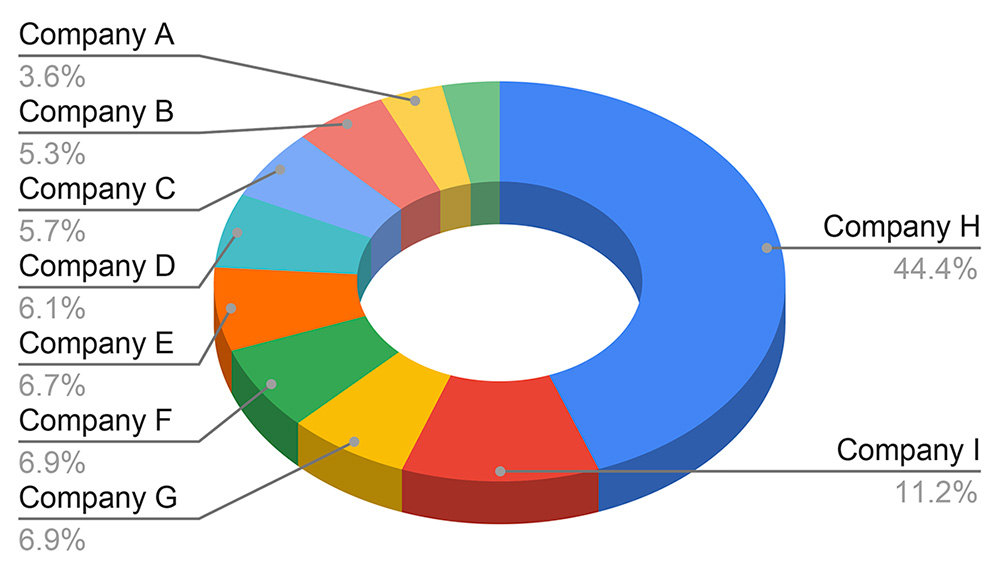
Decisions By Top 10 Insurers
*Sample Chart
Statistical Report fees are based on the complexity of your data request
Learn More & Get a Quote Here >
The Tribunal found:
-
- The flaws in IE reports diluted the causation arguments specifially, “I find that, while the applicant has not produced a physician opinion that his MRI-indicated spine conditions were due to the accident, the IE report of Dr. Khan is equivocal on the cause of applicant’s spine conditions. I find that Dr. Khan opines that the applicant’s MRI findings will not prevent healing of his accident-related soft-tissue injuries, but that Dr. Kahn is silent on whether the disc degeneration is caused (or not) by the accident. I find that Dr. Khan makes comments on whether the applicant had pre-existing injuries that were exacerbated by the accident, even though the applicant did not make claims of a pre-existing injury. For this reason, I assign little weight to the respondent’s argument, via Dr. Khan, that the applicant’s 2025 spine impairments were unrelated to the accident.”
- Applying Sabadash, the Tribunal inferred that the accident was at least partly responsible for the progressive degeneration of Osorno’s spine. Because Osorno had no pre-accident pain, and because his symptoms began with the accident and steadily worsened into the severe structural abnormalities shown in the 2025 MRI, the “but for” test was satisfied on a balance of probabilities.
- An applicant does not require a formal expert report or explicit diagnosis to establish chronic pain. The Tribunal affirmed that consistent self-reporting of severe, constant pain to treatment providers for several years, extending well beyond normal healing times, is sufficient to prove the condition.
- Primmum’s argument that missed appointments and inconsistent medication adherence undermined Osorno’s credibility did not align with Dhillon v. Aviva, where the Tribunal found that gaps in active treatment or a failure to strictly follow medical advice do not cancel out documented, ongoing complaints of pain to health care practitioners.
- While Osorno could continue working full-time as an accountant, his inability to sustain the bending and lifting required for his part-time bartending job, coupled with his withdrawal from recreational sports, sufficiently demonstrated a detrimental impact on his normal life function.
Need a briefing on recent MIG trends or a case law training session for your team? We can help.
Contact us today or reach out on live chat to set up a tailored session or request a stat report and summary of recent MIG rulings.
inHEALTH Keeps you LAT inFORMED With Access To:
1. LAT Compendium Database – a relational database of LAT and Divisional Court Decisions equipped with multiple search options, Smart Filters, and concise case summaries
2. Notifications: – weekly LAT inFORMER delivered to your inbox Wednesdays; Newly Added Decisions on Fridays and Breaking News as and when it happens
3. Research Support: – inHEALTH’s Live Chat Experts for guided searches and technical inquiries.
Sign up for a 14 day free trial below to experience the service and see how it can help guide your decision making.